

Proprioception and Children's Shoe Choice: A Guide for Parents
Proprioception, also known as deep sensibility, is the sense of body awareness without visual feedback. For children between 1 and 10 years old, this sense is crucial: it controls coordination, balance, and overall motor development. Therefore, the choice of children's shoes with regard to proprioception involves much more than just optics or brand. Shoes with soles that are too thick and stiff block sensory signals from the ground. Only shoes with flexible, thin soles and a good fit truly allow for the natural perception of the feet.
1. Proprioception in Children: What it Means and Why Shoes Matter So Much
Proprioception is the sense by which the brain always knows where body parts are located. Children who get little exercise or constantly walk in stiff shoes often show deficits in coordination and balance. This is not a small problem: children who do not develop good body awareness often have more difficulties later in life with sports, writing, and even concentrating.
Shoes are the decisive factor here. They are the only thing standing between a child's foot and the ground. Every millimeter of extra sole means less sensory signal. And less signal means less training for the proprioceptive system.
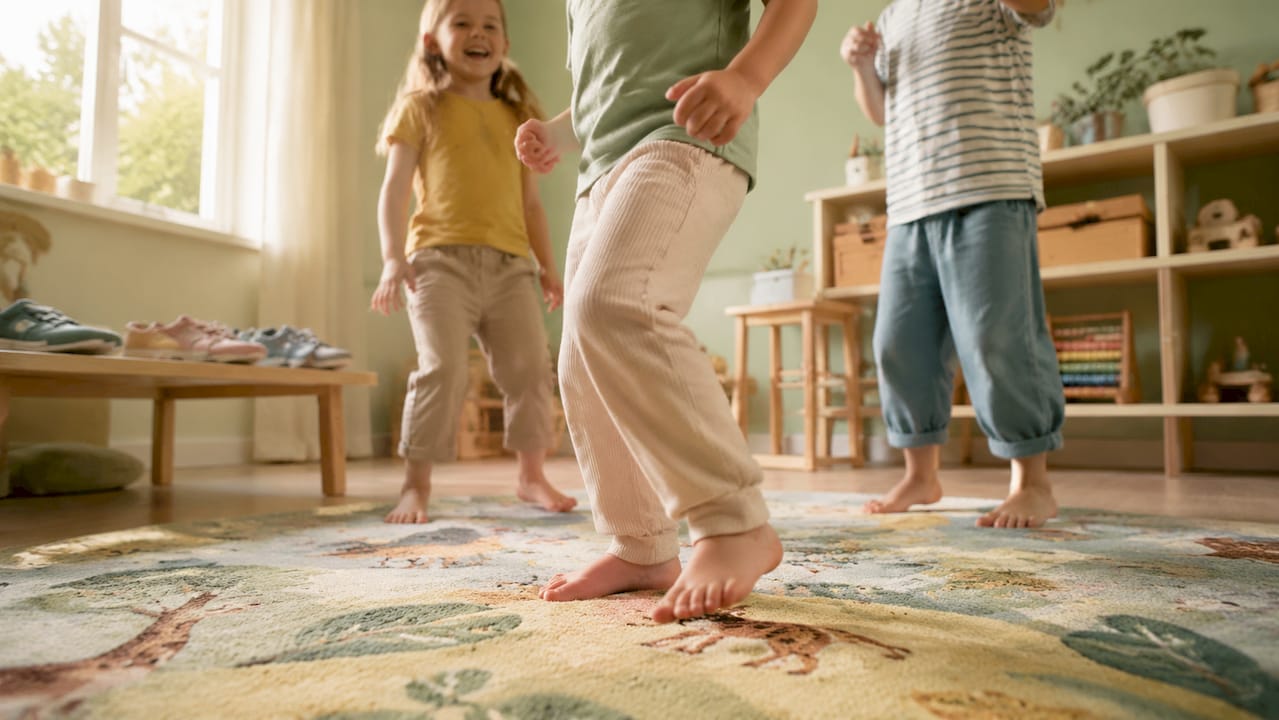
In addition, proprioceptive training not only improves movement safety but also has a positive effect on concentration and learning ability. Good shoes are therefore not a luxury, but a real contribution to a child's development.
2. Which Sole Thickness and Material Promote Proprioception?
The optimal sole thickness for children's shoes ranges between 1 and 10 mm, depending on age. Younger children benefit from thinner soles because their proprioceptive system is still developing and needs as much ground contact as possible. Older children, who walk a lot on hard surfaces, can tolerate a little more sole, as long as flexibility is maintained.
Stable, overly thick soles reduce sensory feedback and hinder motor development. This is especially true for shoes with foam padding, which decouple the foot from the ground. Rubber soles with a uniform, thin thickness, however, provide a good ground feel and are also durable.
The following features help with selection:
- Sole thickness under 10 mm for children up to 6 years old, preferably 3–6 mm
- Uniform thickness across the entire sole, no raised heel
- Rubber material with sufficient grip, but without a thick foam layer
- No reinforcements in the midfoot area that block natural rolling
- Lightweight, so the foot is not unnecessarily burdened
Pro-Tip: Place the shoe on a table and push the toe upwards. If it bends easily and evenly, the sole is flexible enough. If it remains stiff or only kinks in one spot, it is unsuitable for small feet.
You can find more about the benefits of flexible soles for foot development in the Ebmini blog.
3. How to Recognize the Right Fit for Healthy Children's Feet?
The fit is just as important as the sole. A shoe that is too tight forces the toes into an unnatural position. This not only impairs proprioception but also leads to deformities in the long run.
Pediatric orthopedists expressly warn against relying on brands or size specifications because shoe sizes are not standardized. The key is always to measure foot length and test the shoe in motion.
Here's how to check the fit:
- Measure the foot: Have the child stand on a piece of paper and trace the outlines of both feet. Measure the length from the heel to the longest toe.
- Check for room to grow: There should be 12 to 17 mm of space between the longest toe and the tip of the shoe. This is roughly the width of a thumb nail.
- Test toe box width: The toes should be able to spread freely in the shoe without pressing against the sides.
- Check heel hold: The heel must sit firmly in the shoe when walking. If the shoe slips backward when walking, it is too big or too wide.
- Do a walking test: Let the child take a few steps and observe whether they roll their foot naturally or curl their toes.
- Check size every 3–6 months: Children's feet grow quickly. An incorrect fit leads to clawing of the toes and permanently impairs biomechanics.
A detailed guide to determining children's foot width can be found at Ebmini.
4. Cushioning and Flexibility: How Much Protection Does a Child's Foot Really Need?
Strong cushioning sounds like protection. In fact, it reduces ground feel and is detrimental to balance and coordination. This is a real contradiction to what many parents intuitively assume.
Flexibility and ground sensitivity are more important for healthy proprioception than maximum cushioning. This doesn't mean that cushioning is always wrong. For intense sports on hard surfaces, light cushioning can be useful. But as a standard feature for everyday shoes, it does more harm than good.
What to look for in cushioning and flexibility:
- Flexibility test: The shoe should bend easily in the forefoot area, precisely at the ball of the foot.
- Torsion test: Hold the shoe at the heel and toe and twist it gently in opposite directions. It should twist a little, but not be completely soft.
- No raised heel: Zero-drop shoes, i.e., shoes without a height difference between the heel and forefoot, promote natural posture.
- Light sole instead of foam block: Thin rubber soles provide more feedback than thick EVA foam soles.
Pro Tip: Observe how your child walks barefoot. If they walk on tiptoes or stomp their heels heavily, it could be a sign that they are getting too little ground feel from their current shoes. Then switch to a more flexible model and give the child daily barefoot time.
More information on testing the flexibility of children's shoes can be found in the Ebmini blog.
5. Practical Tests: How to Check Shoes Yourself at Home
Parents don't need to be experts to recognize good shoes. A few simple tests are enough to assess whether a shoe supports natural foot development.
A simple flex and torsion test shows whether the shoe supports natural rolling and foot rotation. Even sole wear and sufficient toe room are further indicators of a well-fitting shoe.
Checklist for the shoe test at home:
- Forefoot flex test: Push the toe of the shoe upwards. The shoe should bend at the ball of the foot, not in the middle.
- Torsion test: Hold the heel and toe and twist them in opposite directions. Slight twisting is good, complete softness is not.
- Weight test: Weigh the shoe in your hand. It should be light for its size.
- Walking test barefoot vs. with shoe: Let the child walk on different surfaces. Does the gait change significantly when the shoe is on?
- Observe toe spread: Barefoot, toes spread when stepping. This should be possible in the shoe as well.
- Check rolling motion: The child should roll from the heel over the ball of the foot to the toe. If they stomp flat or walk on tiptoes, the shoe does not fit.
- Analyze sole wear: Look at old shoes. Even wear is a good sign. Heavy wear on one side indicates uneven loading.
| Test | What you check | Good sign |
|---|---|---|
| Flex test | Flexibility in the forefoot | Bends at the ball of the foot |
| Torsion test | Sole twistability | Slightly twistable, not floppy |
| Walking test | Gait with and without shoe | Little difference from barefoot walking |
| Toe spread | Space in the toe box | Toes spread freely |
| Sole wear | Loading pattern | Even across the sole |
The size checklist for children's shoes from Ebmini complements these tests with further practical tips.
6. When You Should Consult a Specialist
Good shoes don't solve every problem. Some children need professional support, and it's important to recognize this early.
In case of persistent foot pain or an unusual gait, a specialist should be consulted to prevent damage. Individual orthopedic insoles may be necessary if shoes and other measures do not bring improvement.
You should take the following warning signs seriously:
- Persistent pain in the foot, knee, or back after walking
- Pressure marks or blisters that occur regularly, even with seemingly well-fitting shoes
- Significant asymmetry in gait, for example, if one foot turns inward or outward
- No improvement despite changing shoes and regular barefoot periods
- Numbness or tingling in the foot after wearing shoes
A pediatric orthopedist or orthopedic shoe technician can create custom insoles and professionally analyze the gait. Early prevention prevents small deformities from developing into lasting problems.
Key Takeaways
Shoes with flexible, thin soles, wide toe boxes, and a good fit are the most important prerequisite for children to develop their proprioception healthily.
| Topic | Details |
|---|---|
| Sole thickness | Age-dependent 1–10 mm; the younger the child, the thinner the sole |
| Checking fit | Measure every 3–6 months, allow 12–17 mm space in front of the toes |
| Cushioning and flexibility | Ground sensitivity is more important than maximum cushioning; perform a flex test at home |
| Self-test at home | Flex, torsion, and walking tests show whether a shoe supports natural walking |
| Consult a specialist | Don't wait for persistent pain, deformities, or uneven sole wear |
What I've Really Learned After Years with Children's Shoes
Many parents buy shoes based on appearance or brand trust. This is understandable, but it often leads to wrong decisions. I've observed that even well-intentioned shoes with thick soles and a lot of cushioning can hinder foot development because they simply give the child too little ground feel.
What surprised me most: Children who regularly walk barefoot and wear shoes with thin, flexible soles show significantly better balance skills. This is no coincidence. Walking barefoot on various surfaces strengthens foot muscles and improves proprioception in a way that no shoe can fully replace. But a good shoe can support this effect instead of suppressing it.
My honest advice: Let your child walk barefoot as often as possible, on grass, sand, gravel, and wooden floors. And when shoes are necessary, choose ones that feel as little as possible. Targeted exercises like balancing and standing on one leg complement this wonderfully and are fun at the same time. Children don't need expensive special shoes. They need shoes that get out of their way.
— Ebmini
Ebmini Barefoot Shoes: Healthy Shoes for Little Feet
For those looking for shoes that actively promote proprioception, Ebmini offers a clear answer. Ebmini's barefoot shoes for children are designed with thin, flexible soles, wide toe boxes, and zero-drop construction. This means maximum ground feel with simultaneous protection.

The models are available for various activities and age groups, from first steps to school age. For summer, there are light barefoot sandals for children, and comfortable sneakers for everyday wear. All models are waterproof, ultralight, and non-slip. The online shop also offers detailed size advice to ensure the right fit from the start. If you want to buy truly healthy shoes for your child, Ebmini is the right place.
FAQ
What does proprioception mean for children?
Proprioception, also known as deep sensibility, is the sense by which the brain perceives the position and movement of the body without looking. In children, this sense is crucial for coordination, balance, and motor development.
Which shoes best promote proprioception in children?
Shoes with thin, flexible soles, a wide toe box, and no raised heel best promote proprioception. They allow the foot enough freedom of movement and provide sufficient ground feel.
How often should I check my child's shoe size?
Every 3–6 months, because children's feet grow quickly. There should always be 12–17 mm of space between the longest toe and the tip of the shoe.
Is a lot of cushioning good in children's shoes?
No. Strong cushioning reduces sensory feedback and can slow down the development of proprioception. For everyday use, shoes with less cushioning and good ground sensitivity are more suitable.
When should I take my child to a pediatric orthopedist?
For persistent pain, pressure points, significant gait asymmetries, or if the gait does not improve despite well-fitting shoes. Early consultation prevents permanent deformities.


