

Toddler Sandals: Guiding First Steps Correctly
The ideal sandal for toddlers in the walking phase is flexible, has a wide toe box, and allows for approximately 1.5 cm of growth room. These three characteristics determine whether a shoe supports or hinders natural foot development. Those looking to buy toddler sandals are faced with a multitude of models. This guide shows what really matters, how to find the right size, and what are the most common mistakes made during purchase.
What requirements should sandals for first steps meet?
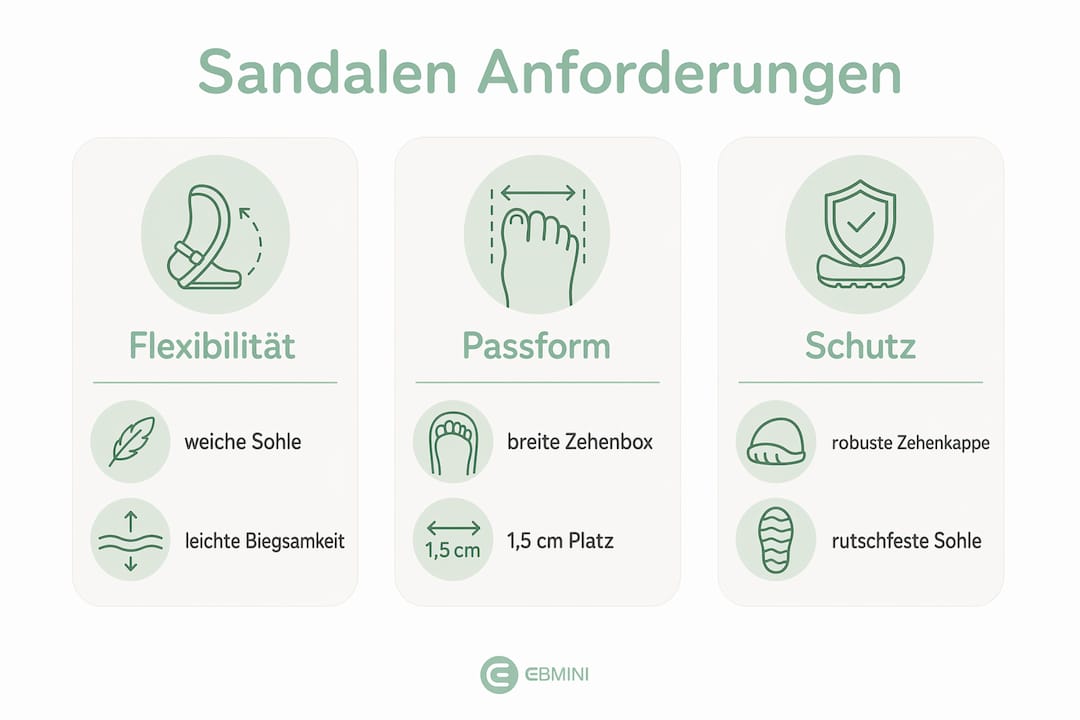
First step shoes primarily need to do one thing: leave the foot alone. This sounds simple, but it is the decisive difference compared to adult shoes. A child's foot during the walking phase still consists largely of cartilage. Sandals that are too tight or too stiff can permanently deform this cartilage.
Experts recommend flat, flexible soles without pronounced arch supports for toddlers. A firm insole sounds like support, but it weakens the foot muscles. The foot only learns to stabilize itself if it is allowed to do so.
The most important features at a glance:
- Flexible sole: The sandal should be easy to roll. If you bend it in the middle and it resists, it's too stiff.
- Wide toe box: Toes must be able to spread freely. Toe freedom promotes balance and a natural gait.
- Non-slip sole: Grip is essential, especially on smooth floors, tiles, or wet surfaces.
- Breathable material: Toddlers' feet sweat a lot. Sandals made of leather or microfiber allow air to circulate.
- Adjustable closure: Velcro fasteners adapt to the foot and can also be opened by small children's hands.
Pro Tip: Place the sandal on the floor and press on the sole with your thumb. If it yields, the flexibility is good. If it springs back immediately like a plank, stay away from it.
The growth allowance of approx. 1.5 cm is not an arbitrary value. Too little space squeezes the toes. Too much space causes the foot to slide in the sandal, which encourages tripping.
How to determine the right size for toddler sandals?
A toddler's shoe size changes quickly. Some children grow half a size within three months. Therefore, it is worth re-measuring the foot regularly, not just when buying.
Here's how to measure step by step:
- Place foot on paper: Have the child stand upright, place their foot on a sheet of paper, and mark the longest toe and the heel.
- Measure length: Measure the distance between the two marks in centimeters. This is the foot length.
- Measure width: Also measure at the widest part of the foot (usually across the ball). Wide feet need sandals with a correspondingly wide toe box.
- Factor in growth allowance: Add 1.2 to 1.5 cm to the foot length to get the ideal inner length of the sandal. A foot of 11 cm therefore needs a sandal with an inner length of approx. 12.5 cm.
- Check straps: After putting them on, a finger should fit loosely between the strap and the foot. If the strap presses, it is too tight. If it slips, there is not enough support.
Pro Tip: Always measure the foot in the afternoon. Children's feet swell slightly during the day. A sandal that fits in the morning may pinch in the afternoon.
The width of the foot is often forgotten. Many parents buy the correct length but a sandal that is too narrow. The result: the toes are squeezed sideways, even though there would be enough space at the front. Anyone who wants to ensure toe freedom correctly must keep both measurements in mind.
What materials and designs are recommended for toddler sandals?
The material of a sandal determines how comfortable it feels, how long it lasts, and whether it is suitable for sensitive children's skin. Not every material suits every child.
Natural leather is breathable, pliable, and durable. It adapts to the foot and rarely causes allergies. The disadvantage: leather requires care and is not vegan. Those who want to avoid animal products can find good alternatives today. Vegan materials made from pineapple waste, for example, offer similar breathability with sustainable production. Natural rubber soles are flexible and non-slip at the same time.
| Feature | Open Sandal | Sandal with Toe Cap |
|---|---|---|
| Toe protection | Low | High |
| Air circulation | Very good | Good |
| Suitable for playground | Conditional | Yes |
| Suitable for heat | Very good | Good |
| Recommended for walking phase | Conditional | Yes |
Robust toe caps protect sensitive feet during the walking phase. Toddlers stumble. They bump into stones, table legs, and toys. A closed toe cap prevents bruises without restricting freedom of movement.
The design of the closure influences everyday life more than many people think. Adjustable straps with Velcro fasteners adapt to the foot, even if it is slightly swollen in summer. Fixed buckles look chic, but are more difficult for toddlers to handle. The zero-drop principle, i.e., a completely flat sole without a heel, keeps the foot in a natural position and promotes healthy posture from the start.
How to choose sandals for different everyday situations?
Not every sandal suits every occasion. A toddler who plays all day at the playground needs different shoes than one who is at a family celebration. The good news: with two to three pairs, almost every situation can be covered.
For everyday outdoor use, durability and support are key. The sole must perform equally well on sand, grass, and asphalt. Barefoot sandals with a flexible natural rubber sole and Velcro closure reliably meet these requirements. For toddlers who are still wobbly on their feet, a good heel strap is particularly important. It prevents the sandal from falling off when walking.
The following points help with selection depending on the situation:
- Playground and outdoors: Sandal with a toe cap, non-slip sole, and heel strap. Material can be a bit more robust.
- Hot summer day: Open models with less material on the foot. Important: still enough support with at least two straps.
- Festive occasions: Softer material, appealing design. Here, the sandal can be a little less robust, as the wearing time is shorter.
- At home: Light slippers or barefoot are often better than sandals. However, on smooth floors, the child needs non-slip soles.
Caring for sandals significantly extends their lifespan. Regularly clean leather with a damp cloth and occasionally treat it with leather care products. Vegan materials can usually be cleaned with water and mild soap. Store sandals in the air after drying, never directly on a heater. Checking the fit every four to six weeks will let you know in time if the sandal has become too small.
Typical mistakes when buying toddler sandals
The most common mistake when buying toddler sandals is the wrong size. Parents often buy too large, believing the child will quickly grow into them. While this is true, sandals that are too large promote slipping and stumbling. Sandals that are too small, in turn, lead to deformities. Both harm development.
Other common mistakes:
- Soles that are too stiff: Sandals that are difficult to bend force the foot into an unnatural rolling motion. This tires the muscles and slows down learning to walk.
- Narrow toe box: If the toes are squeezed together, the child loses some of their natural balance. Toe freedom is crucial for wobbly first steps.
- Wrong material choice for sensitive skin: Synthetic materials without breathability can cause skin irritation in some children. If you have a child with sensitive skin, you should opt for leather or tested vegan alternatives.
- Not regularly checking the fit: Children's feet grow quickly. A sandal that fit in May may already be too small in August. Monthly checks are not a hassle, but a precaution.
- Prioritizing appearance over function: Many parents choose sandals based on color or design. This is understandable, but function must always take precedence.
Knowing these mistakes will help you make much better decisions on your next purchase. And your child will walk more safely, comfortably, and healthily.
Key findings
The best sandal for toddlers in the walking phase is flexible, has a wide toe box, and allows 1.2 to 1.5 cm of growth room so that the foot can develop freely and naturally.
| Topic | Details |
|---|---|
| Sole flexibility | The sole must be easily bendable to allow natural rolling. |
| Toe box | A wide toe box allows the toes to spread and promotes balance and stability. |
| Determining size | Measure foot length and add 1.2 to 1.5 cm to get the ideal inner length. |
| Material choice | Leather or tested vegan alternatives are breathable and skin-friendly. |
| Avoiding mistakes | Sandals that are too large or too small equally harm foot development. |
What I truly believe after years of observation
Parents often ask me if a sandal with arch support isn't better for support. My answer is always the same: support is the wrong goal. A toddler's foot doesn't need support. It needs space to train itself.
I have observed that children walk more securely and quickly in truly flexible sandals with a wide toe box than children in stiff models. This is not magic. It's because the foot muscles are allowed to work with every step. Taking this work away from the foot delays its development.
Another point that many underestimate: toe freedom. Parents see that there is still space at the front and think everything is fine. But if the sandal is too narrow on the sides, the toes are still squeezed. The child loses balance and security without anyone noticing. That's why the width of the foot is just as important as the length.
My honest advice: Buy one less sandal and invest in a model that truly fits. A well-fitting shoe that supports foot development is worth more than three colorful pairs that restrict the child's movement. And check the fit regularly. Children's feet don't wait.
— Ebmini
Healthy barefoot sandals for your child's first steps
Ebmini has developed barefoot sandals that offer exactly what toddlers in the walking phase need: a flexible natural rubber sole, a wide toe box, and a zero-drop design without a heel. The materials are vegan, pollutant-tested, and breathable.

The Velcro closure can be opened and closed quickly, even by small children's hands. The non-slip sole holds on grass, sand, and smooth surfaces. All models are ultralight, so the child hardly feels the shoe. Those looking for the best sandals for toddlers will find a selection at Ebmini that is geared towards natural foot development. For the very first steps, there are also soft crawling shoes that gently accompany the transition from crawling to walking.
FAQ
When should a toddler get their first sandals?
As soon as a child starts taking their first steps, they can wear sandals. It is important that the sandal is flexible and offers enough space for the toes.
How much space should a toddler sandal have at the front?
The ideal growth allowance is 1.2 to 1.5 cm between the longest toe and the front end of the sandal. Less space squeezes the toes, more space causes the foot to slip.
Are barefoot sandals really better for toddlers?
Yes. Barefoot sandals with flexible soles and wide toe boxes promote foot muscles and natural gait. Stiff soles and narrow toe boxes hinder development.
Which closure is best for toddlers?
Velcro fasteners are the most practical choice. They can be opened and closed quickly, adapt to the foot, and provide a secure hold through adjustable straps.
How often should I check my toddler's shoe size?
Every four to six weeks is advisable. Children's feet grow quickly and irregularly. A sandal that fit in spring may already be too small in summer.


