

Sandals Fit for Children: Foot Width and Comfort
Many parents buy sandals one size larger, thinking that takes care of everything. But even high-quality sandals often don't fit correctly because foot width is completely ignored. Children's feet are not just small adult feet. They grow quickly, change in shape and volume, and an incorrect fit can seriously impair natural foot development. Knowing the right criteria—length, width, room to spare, and material quality—protects your child's feet and simultaneously saves money through smart purchasing decisions.
Table of Contents
- The Growth of Children's Feet and the Importance of Fit
- Foot Width and Size: How to Find the Right Sandal
- Comfort and Sustainability: What to Look for in Materials
- Nuances and Mistakes: What to Absolutely Watch Out For
- Parental Perspective: What Really Matters When Choosing Sandals
- Fit and Comfort: Ebmini® Solutions for Small Feet
- Frequently Asked Questions About Children's Sandal Fit
Key Insights
| Point | Details |
|---|---|
| Regular Remeasurement | Children's feet grow quickly and frequently require a reassessment of sandal size. |
| Check Width According to WMS | For an ideal fit, foot width must be determined using the WMS system. |
| Choose Flexible Comfort Features | Breathable materials and adjustable straps ensure maximum adaptability and foot health. |
| Don't Just Trust Marketing | Even with labels like "wide toe box," parents should pay attention to the actual fit and lateral support. |
The Growth of Children's Feet and the Importance of Fit
Children's feet grow at a pace that many parents underestimate. Especially in the first few years of life, shoe size can change within a few months. For toddlers up to three years old, feet grow by an average of up to two centimeters per year. Between four and six years, growth slows down somewhat but remains constant. This means that sandals that fit perfectly in spring might already be too tight by late summer.
Children's feet can change in length and width several times a year. If you only check the fit at the time of purchase, you risk your child wearing ill-fitting shoes for months.
What many don't know: Children's feet even change their measurements throughout the day. In the morning, feet are often a little narrower; in the afternoon, after hours of walking, they are a little wider and thicker. Therefore, the fit should always be assessed when the foot is bearing weight, i.e., when the child is standing and walking, not when sitting or lying down.
The most common mistakes when buying sandals are easily identified:
- Sandals are bought "in advance" too large, leading to tripping and unstable gait
- Foot width is not measured, although it is just as important as length
- Parents rely on numbers like shoe size 28 without measuring the actual foot
- The child is not observed during fitting to see if they spread or curl their toes
- Sandals are worn for too long, even when the child has long outgrown them
The recommended room to spare between the longest toe and the edge of the shoe is at least 12 mm and a maximum of 17 mm. Less than 12 mm means pressure points and cramped toes. More than 17 mm leads to the foot "swimming" in the sandal and an unstable gait.
Pro-Tip: Always measure your child's foot length in the afternoon, when the foot is slightly swollen from activity. Have your child stand on white paper, trace the outline, and measure the distance from the heel to the longest toe. Then add the recommended room to spare. This will give you the optimal insole length for the next sandal.
A practical fit checklist for children's shoes can help you proceed systematically and not overlook any important points. Especially when buying during the transition period, when temperatures and activity levels fluctuate, it's also worth looking at the best model choice for the transition period.
Foot Width and Size: How to Find the Right Sandal
Now we come to the often-neglected topic: foot width. Width describes how broad and voluminous the foot is. It is measured as the circumference at the widest part of the foot, i.e., in the ball area. Two children with identical foot length can have completely different widths. A sandal made for a narrow foot will pinch the sides of a wide foot, causing pain, blisters, and long-term deformities.
The WMS system is the most important tool for determining width in children's shoes. WMS stands for Weite (width), Mass (measurement), and Schuh (shoe) and distinguishes three categories: S for narrow, M for medium, and W for wide. The WMS system takes into account the three-dimensional structure of the child's foot, i.e., not only the width, but also the volume and instep height. Many shoe stores offer WMS measurements, but width can also be well estimated at home.
How to determine your child's foot width in five steps:
- Have the child stand with their foot on white paper and trace the outline
- Measure the widest part of the foot across, i.e., the distance from the outer edge of the little toe to the inner edge of the big toe
- Compare this value with a current size chart that includes WMS categories
- Additionally, check the instep by loosely wrapping a measuring tape around the ball of the foot and noting the circumference
- Then choose the sandal model that fits both the measured length and the determined width
| Width Category | Foot Profile | Fit Note |
|---|---|---|
| S (narrow) | Narrow, flat foot | Requires tighter strap guidance |
| M (medium) | Average foot | Fits most standard models |
| W (wide) | Wide, full foot | Requires extra-wide toe box and flexible straps |
A common problem in practice: parents buy the correct length, but the wrong width. The result is sandals where the side panels pinch the foot, even though there is still space at the front. If the child immediately loosens the straps after putting them on, it's a clear sign of insufficient width.
Pro-Tip: When trying them on, don't just look at the toe box, but gently press on the side of the sandal. If you feel the child's foot directly and the child flinches or rejects the sandals, the side panels are too tight. Ideally, a small but noticeable buffer should remain between the foot and the sandal edge.
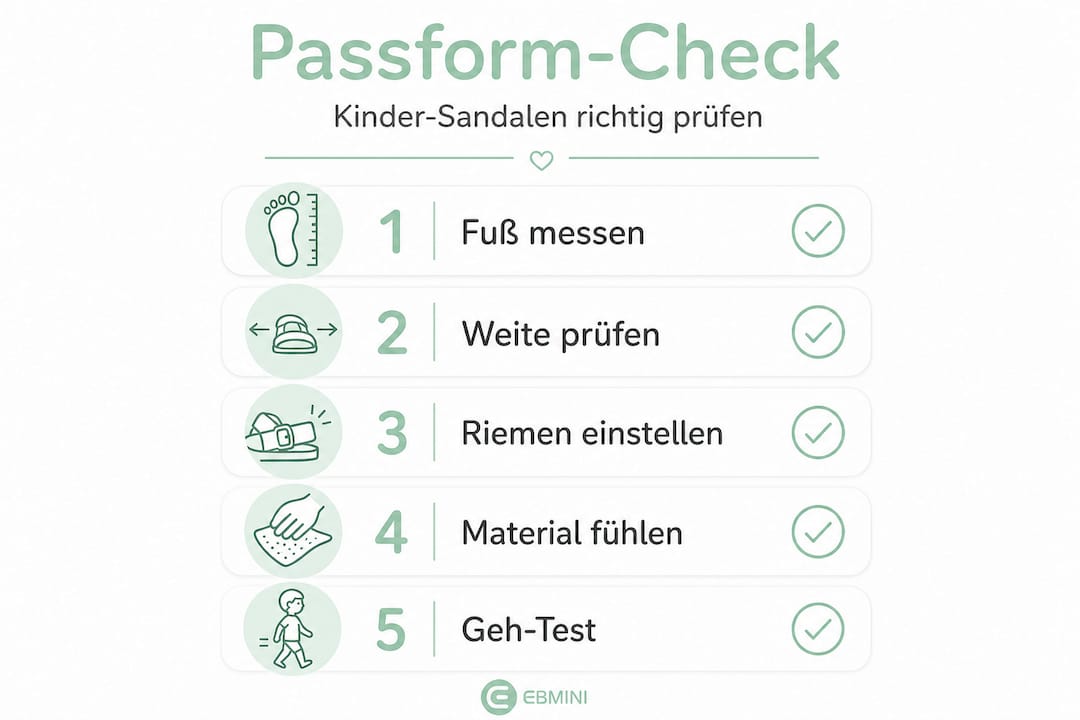
A comprehensive size checklist helps you proceed systematically with every new purchase. If you are still unsure which model offers the right width structure, you can find models that are specifically designed for natural foot shapes and different widths among children's barefoot shoes. Especially during the transition period, it's worth taking a look at finding the best model to avoid having to buy twice.
Comfort and Sustainability: What to Look for in Materials
Fit is crucial, but the material makes the difference between a good sandal and a truly great one. Children often wear sandals for hours, walking through grass, sand, water, and over pavement. The material must withstand all of this without harming the foot.
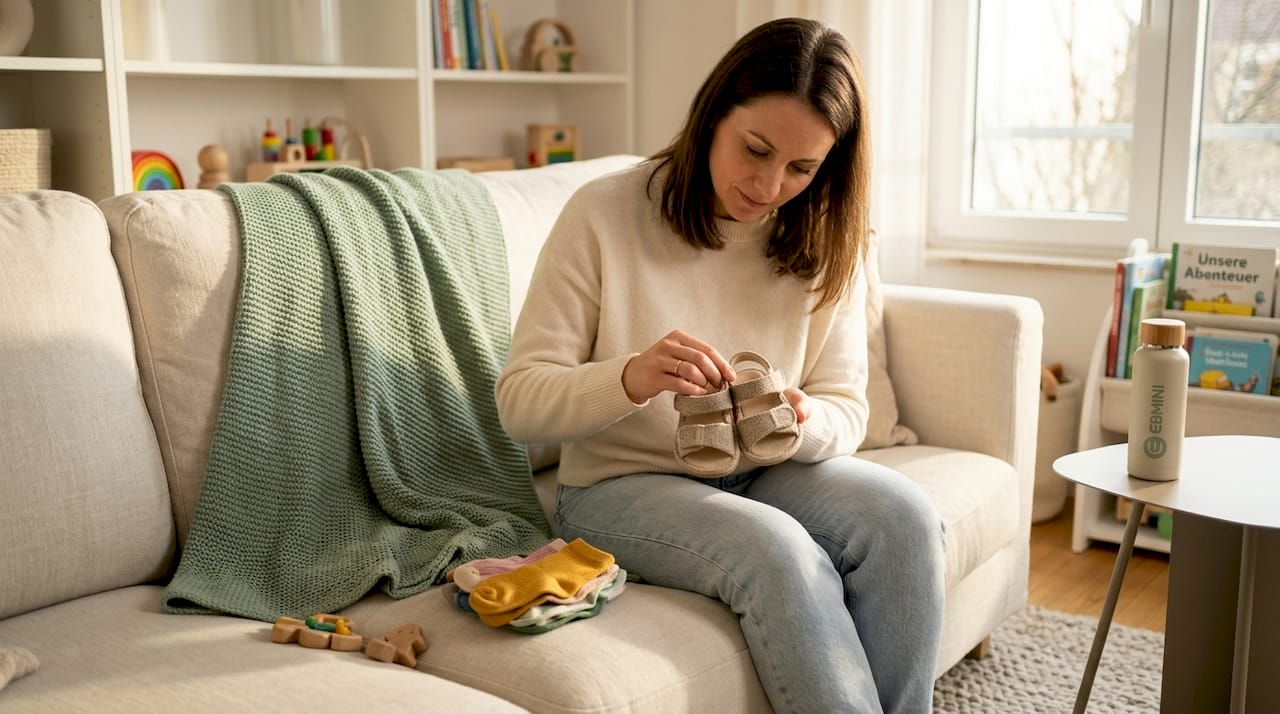
Breathable materials are not a luxury, but a must. Synthetic plastics that do not allow air to pass through well create heat and moisture. This quickly leads to sweating, odor, and in the worst case, fungal infections or skin irritations. Natural materials like organic cotton, natural rubber, or certified leather breathe significantly better and regulate temperature more naturally.
A good practical example: Sandals made from 100% organic cotton with a padded ergonomic footbed and non-slip sole show what is possible when manufacturers consistently combine comfort and sustainability. The footbed distributes the child's weight evenly and prevents pressure points that arise with flat, unlined soles.
| Feature | Minimum Requirement | Optimal Design |
|---|---|---|
| Material | Breathable, pollutant-free | Organic cotton, natural rubber |
| Sole | Non-slip, flexible | Zero-drop, flexible outsole |
| Straps | Adjustable | Multi-adjustable, soft material |
| Weight | Light | Ultralight under 150 g per shoe |
| Toe box | Sufficiently wide | Extra-wide toe box for toe splay |
The most important comfort features of sustainable children's sandals at a glance:
- Flexible sole: Easily bendable and follows the natural foot movement when rolling off
- Ergonomic footbed: Supports the longitudinal arch without over-supporting it
- Wide toe box: Gives toes room to splay, which is crucial for balance regulation
- Adjustable straps: Adapt to different foot shapes and widths
- Non-slip outsole: Protects against slipping on wet surfaces
- Pollutant-free materials: No formaldehyde, no chromium VI, certified according to OEKO-TEX or similar standard
- Low weight: Relieves the legs and promotes natural movement patterns
Sustainability begins with production and ends with durability. A sandal that falls apart after one season is not sustainable, even if it was made from organic material. Good seams, solid Velcro closures, and robust soles are a sign of quality that will last through several growth stages.
An often underestimated aspect: the sock issue. Many children wear sandals directly on their skin, which can lead to chafing with poorly finished interiors. Wearing breathable children's socks protects sensitive children's skin and extends the life of the sandal at the same time.
Nuances and Mistakes: What to Absolutely Watch Out For
Even those who know all the basics sometimes fall into typical traps. Marketing statements on shoe boxes like "extra wide toe box," "anatomically shaped," or "barefoot-like" sound good, but say little about the actual fit. Caution is advised here.
The central problem: Not every label like "wide toe box" alone solves the fit problem. It is crucial whether the side panels touch the foot without compressing it. A sandal can offer plenty of room at the front, but be so tight in the midfoot area that the ball of the foot is constricted. The child feels this, but does not always communicate it clearly.
The two most common fit errors and their consequences:
Too much room:
- The foot "swims" in the sandal and slides back and forth
- The child curls their toes to hold the sandal on, which creates muscle tension
- The heel lifts when walking, leading to blisters and abrasions
- Unstable gait and increased risk of falling, especially on uneven surfaces
Too little room:
- Pressure points on toes, especially on the big toe and little toe
- Nail bed development is disturbed, which can lead to ingrown nails
- Bruising under the nails after longer outings
- Long-term deformities like bunions (hallux valgus) with constant pressure
Pro-Tip: Always perform three checks when trying on. First: Gently press on the toe box and check if you feel enough space to the longest toe. Second: Press on the side of the sandal and observe the child's reaction. Third: Let the child walk a few steps and observe whether the heel stays in the sandal or lifts.
Other mistakes that can be easily avoided:
- Buying sandals online based only on photos or size charts, without knowing the child's measurements
- Equipping siblings with the same sandals, even though their foot shapes are different
- Hoping for "breaking in" when sandals are uncomfortable from the start
- Buying sandals because the child likes their appearance, without checking the fit
- Forgetting that socks might require half a size more space
For a good practical check, specially designed barefoot models are particularly suitable. The barefoot sandals ENT and the barefoot sandals ELE are designed to avoid typical fit pitfalls from the outset, through wide toe boxes, flexible straps, and natural sole shape.
Parental Perspective: What Really Matters When Choosing Sandals
To be honest, at Ebmini® we've had countless conversations with frustrated parents. Well-intentioned advice from the internet, expensive brand sandals, and still a child complaining after two weeks. This is rarely due to the brand, but almost always because no one really paid close attention.
The truth that many parenting guides don't tell you: No chart, no WMS value, and no marketing claim can replace direct trying-on with the child. Children have an opinion about their shoes. And that opinion is often more precise than you might think. A child who says "they're pinching" or "they feel weird" is usually right. A child who willingly puts on their sandals is a reliable sign of a good fit.
What we've learned from experience: Flexibly adjustable straps are the most important single factor for a good sandal. Why? Because they allow the sandal to be adapted to different times of day, foot shapes, and swelling. A sandal with fixed strap guidance only works well for exactly one foot shape. Everything else is a compromise.
Anyone who remeasures every season will have a surprising realization: Sometimes last year's sandals are still good enough, and sometimes you have to buy new ones after just four months. Both are normal. The disadvantage of looking away is more expensive, namely foot problems at the doctor, new sandals that the child rejects, and lost time.
Ebmini®'s practical fit checklist helps to make this process quick and structured. And for the little ones who are just taking their first steps, it's worth taking a look at barefoot shoes for first steps, because the same principles apply here too: room for the toes, flexible sole, breathable material.
Our conviction: Foot health is not a luxury. It is an investment that will accompany the child throughout their life. Those who pay attention to a good fit today will avoid deformities, pain, and expensive corrections tomorrow.
Fit and Comfort: Ebmini® Solutions for Small Feet
Good fit advice doesn't end with the article. It begins with the right product.
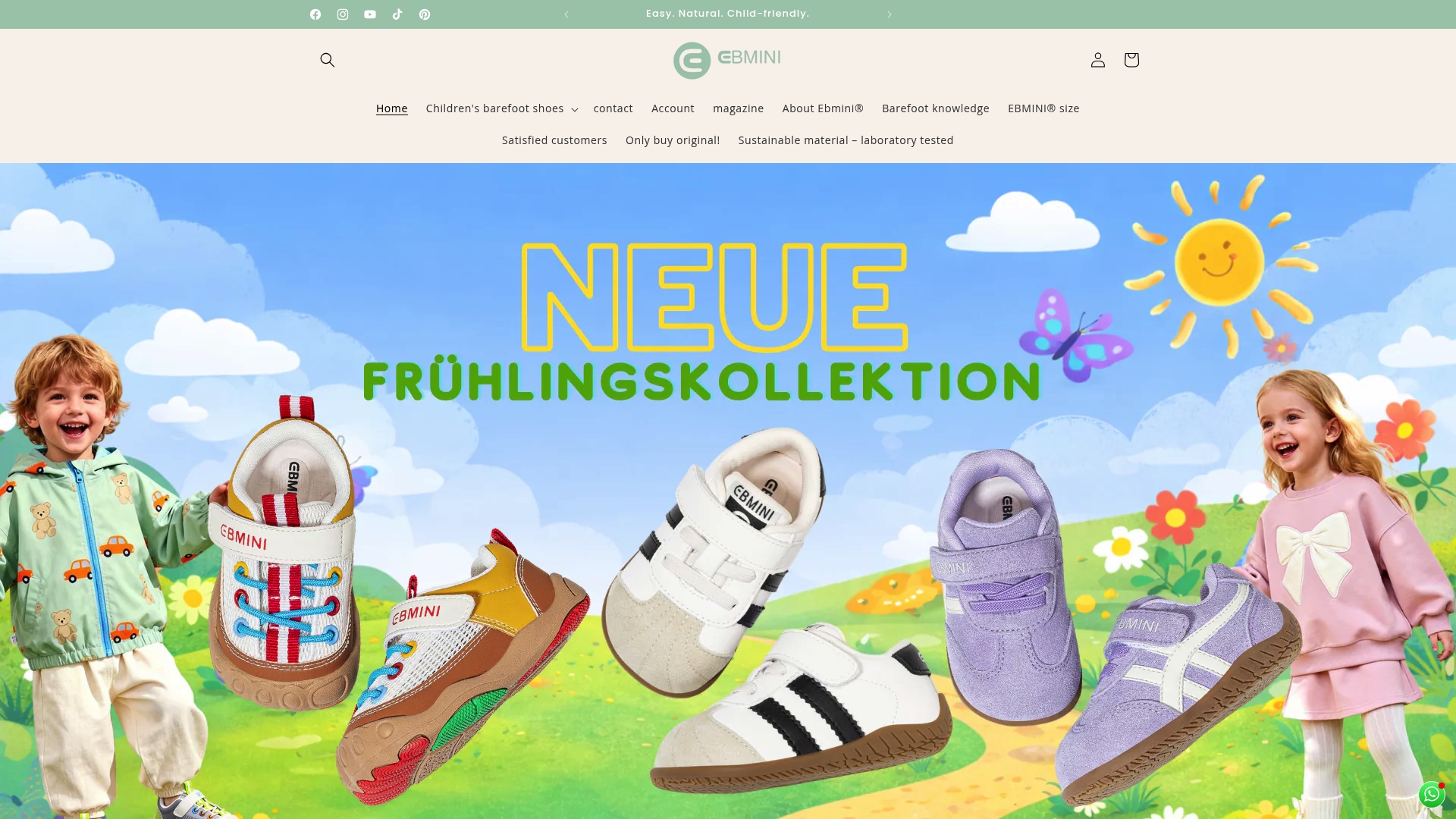
At Ebmini®, we develop summer barefoot sandals specifically for the natural foot development of children aged 1 to 10. Each model follows the principles of barefoot walking: a wide toe box, flexible sole, zero-drop concept, and adjustable straps for all foot widths. The WAWE barefoot sandals impress with an ultra-light design and multiple adjustable straps, ideal for active children with wide feet. For home and transitional periods, we recommend the HAU slippers and sandals, which can be used flexibly indoors and outdoors. All models are made from sustainable, tested materials and are re-released each season.
Frequently Asked Questions about Sandal Fit for Children
How do I correctly measure my child's foot length for sandals?
It's best to measure the foot length while standing with the foot bearing weight, in the afternoon if possible. The recommended space between the toes and the edge of the sandal is at least 12 mm and a maximum of 17 mm.
What does WMS mean and how does the system help with sandal selection?
The WMS system classifies the width of children's shoes into Narrow, Medium, and Wide and takes into account the three-dimensional foot structure, i.e., width, volume, and instep height together.
What comfort features should a children's sandal offer?
Important features include breathable materials, flexible ergonomic soles, and adjustable straps. Sandals with organic cotton and an ergonomic footbed, as well as a non-slip sole, demonstrate how comfort and sustainability can be combined.
How often should I check the fit and size of children's sandals?
It is recommended to check before each season, but at least every three months. Since children's feet grow quickly and measurements change throughout the year, a single measurement at the time of purchase is not sufficient.


