

Shoe Stiffness and its Influence on Gait
Shoe stiffness creates an inclined plane under the foot, forcing muscles, joints, and the entire kinetic chain to compensate with every single step. This may sound abstract, but it has measurable consequences: External eversion angles in the shoe can be sufficient to continuously overstress the knees, hips, and lumbar spine. Understanding how bending stiffness changes gait patterns can help in earlier symptom detection, more targeted intervention, and asking the right questions when buying shoes.
Key points at a glance:
- A sole that is too stiff or too soft changes the foot's roll-off phase and forces compensatory patterns all the way up to the back.
- Typical warning signs: calluses in unusual places, lower leg pain after normal walking, uncertain push-off.
- Three immediate checks: bend test on the shoe, toe box check (thumb-width space), observation of barefoot vs. shod roll-off pattern.
- For pain lasting longer than six weeks, swelling, or sudden limping: consult an orthopedist or podiatrist.
- Especially for children: wide toe box, zero drop, and ultra-flexible soles promote natural foot development. Ebmini® meets these criteria.
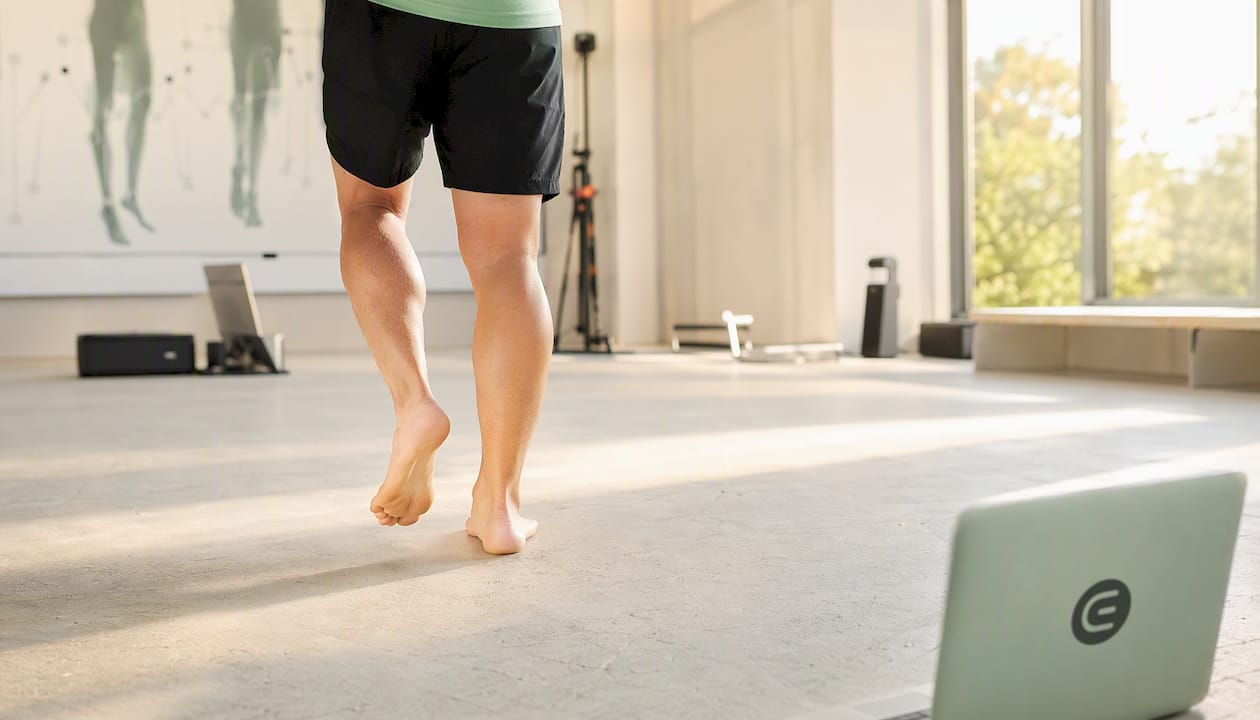
Pro Tip: Film your child or yourself walking from behind and from the side. A direct comparison of barefoot vs. shod walking will reveal compensatory patterns that are barely noticeable in everyday life.
Table of Contents
- What is shoe stiffness, and what shoe characteristics determine it?
- How shoe stiffness changes gait: phases and compensations
- How shoe stiffness affects common foot deformities
- What symptoms and warning signs appear in gait?
- What do experts check in gait analysis and diagnostics?
- What conservative measures really help?
- How to check shoes correctly: a practical checklist
- What experts say: sensory perception, cushioning, and barefoot principles
- Key Takeaways
- Why this topic deserves more attention
- Ebmini® Barefoot Shoes: Foot Health from the Start
- Further sources and studies
What is shoe stiffness, and what shoe characteristics determine it?
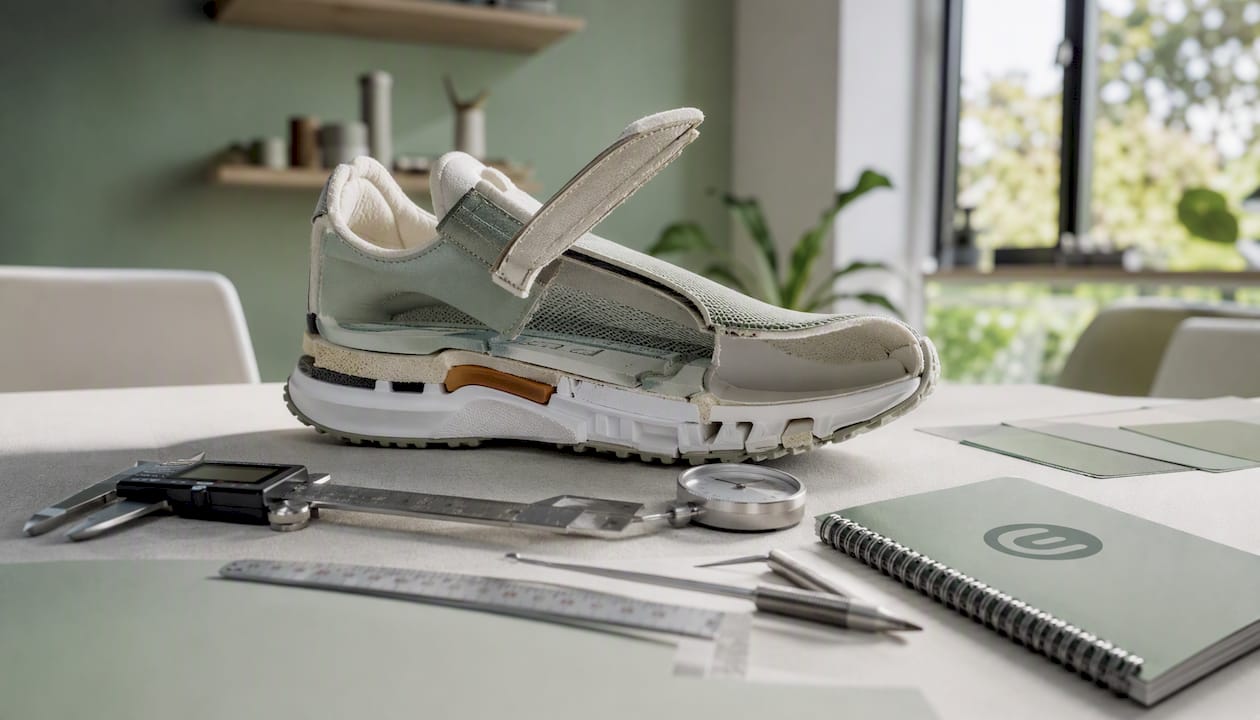
Shoe stiffness, referred to in technical literature as bending stiffness or toe stiffness, describes the resistance a shoe sole offers to bending in the toe area. This is complemented by torsional stiffness, which is the resistance to twisting of the sole around its longitudinal axis. Both together determine how much a shoe restricts or supports natural foot movement.
Which components are specifically involved?
- Sole thickness and material: Thicker EVA or PU soles provide more cushioning but are generally stiffer. Thin rubber soles bend more easily.
- Curvature and rocker radius: A pronounced rocker shifts the roll-off point backward and reduces the active work of the forefoot.
- Toe spring: How much the toe of the shoe curves upward affects whether the toes can actively participate in the push-off.
- Heel counter and heel cup: A hard heel counter provides stability but also restricts natural heel movement.
- Drop (heel-to-toe differential): A high drop shifts body weight forward and alters the load on the Achilles tendon and knee. Zero drop means the heel and forefoot are at the same height.
- Cushioning properties: Soft cushioning reduces impact peaks but also diminishes sensory feedback to the sole of the foot.
Important: Stiffness and guidance are not the same. Orthopedic adjustments like insoles or rockered soles have a specific therapeutic function but differ fundamentally from the general bending stiffness of a ready-made shoe.
Pro Tip: The bend test works like this: Hold the shoe in both hands, pressing the heel and toe together. A good everyday shoe bends exactly where the foot bends: just behind the ball of the foot. If it bends in the middle or not at all, the sole is too stiff. If it can be completely folded, it lacks all support.
How shoe stiffness changes gait: phases and compensations
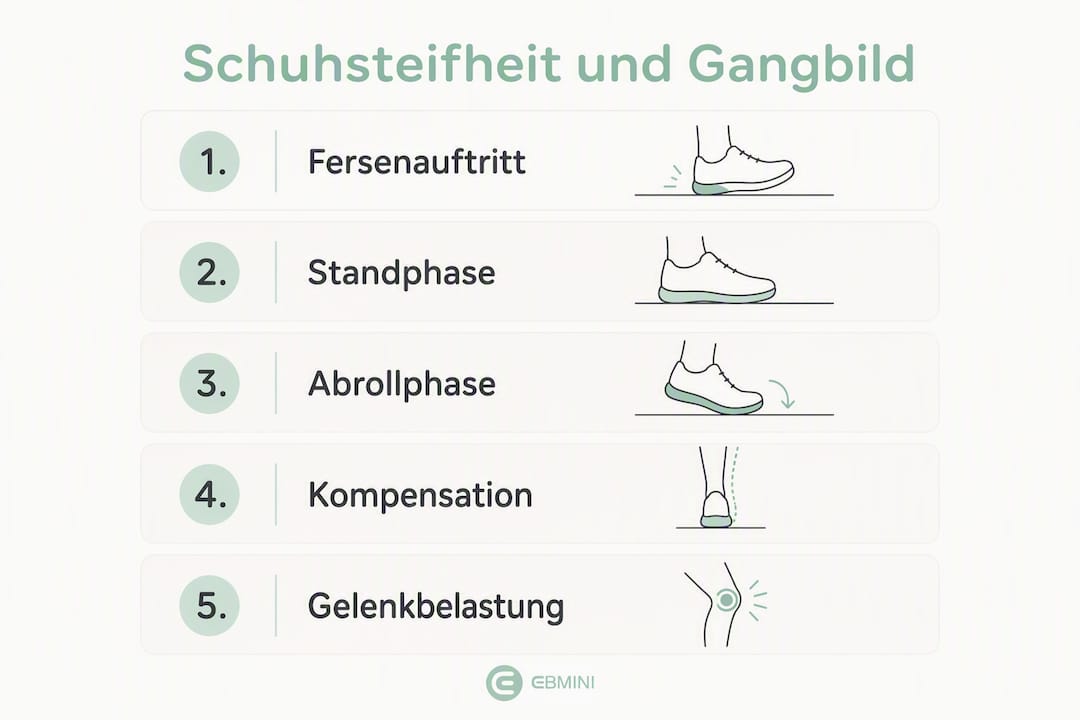
Human walking occurs in three main phases: heel strike (contact phase), support and roll-off phase (stance phase), and push-off (forefoot propulsion). Shoe stiffness primarily affects the roll-off and push-off phases, precisely where the foot performs most of its work.
The inclined plane and what it triggers
Every industrially manufactured shoe creates an inclined plane under the foot. The softer the sole, the more the foot tilts sideways. While this initially sounds like a problem with soft shoes, it also affects stiff models: a sole that is too rigid prevents natural rolling over the ball of the foot and forces the body to compensate for the lack of mobility elsewhere.
What happens specifically then? The lower leg rotates inward, the knee deviates, and the hip rotates compensatorily. Measurements show that this external eversion occurs in over 90% of cases and correlates with knee and lumbar spine complaints (e.g., according to EVERSION user data, 58% of respondents reported LBP complaints). With every step, the body performs an unconscious "rescue operation" to prevent ankle sprains, leading to persistent hypertonicity from the lower leg to the neck.
Compensation patterns from foot to back
A too-stiff forefoot blocks toe push-off. The body compensates by either lengthening the stride (to circumvent the blockage) or shortening it (to expend less energy). Both require more energy than a natural roll-off.
Biomechanical studies show that different sole technologies significantly influence joint loading: Maximalist soles increased knee loading, while rocker soles significantly reduced knee loading and running injury risk over twelve months. This demonstrates that the choice of sole technology is not a matter of comfort but a biomechanical decision with direct consequences for joints and injury risk.
The myofascial chain does the rest. Tension in the lower leg transfers to the popliteal fossa, from there to the hamstrings, further to the sacroiliac area, and finally to the lumbar spine. Anyone with chronic back pain who has never considered their shoes should do so now.
How shoe stiffness affects common foot deformities
Foot deformities and shoe stiffness mutually reinforce each other. No deformity exists in a vacuum, and no shoe fits every foot shape equally well.
-
Flatfoot and pes planus: The longitudinal arch is absent or flattened. A stiff sole prevents collapse but creates pressure points on the inner edge of the midfoot. A too-soft sole allows the arch to collapse completely. Recommendation: moderate longitudinal arch support, flexible forefoot sole, wide toe box.
-
Pes valgus (pronated foot): The heel tilts inward. Soft, yielding soles exacerbate lateral sagging and increase pressure displacement to the inner edge. At the same time, the body reacts with reflexive external rotation in the knee. Recommendation: stable heel counter, torsionally stable midfoot section, no excessive drop.
-
Splayfoot (pes transversoplanus): The transverse arch is flattened, and the metatarsal heads bear too much load. A narrow toe box squeezes the toes together and shifts pressure peaks further onto the metatarsal heads. Recommendation: wide toe box is mandatory, no pronounced curvature in the forefoot area, soft forefoot sole.
-
Pes cavus (high-arched foot): The longitudinal arch is excessively high, and the foot hardly springs. A stiff forefoot sole combined with a high drop increases forefoot pressure and strains the Achilles tendon. Recommendation: flexible sole with moderate cushioning, low drop, no hard heel counter.
-
Equinus foot: The sole of the foot is permanently in plantarflexion; heel strike is absent or reduced. A stiff sole with a high drop can provide short-term relief but exacerbates shortening in the long term. Recommendation: physical therapy as the basis, shoe only as a temporary solution, gradual reduction of the drop.
What symptoms and warning signs appear in gait?
Discomfort caused by shoe stiffness usually develops gradually. This makes it difficult to pinpoint, as shoes are rarely suspected when the back hurts.
- Pain in the forefoot or under the ball of the foot after prolonged walking, especially with narrow toe boxes or strong curvature.
- Calluses and blisters in unusual places, for example, on the outer edge of the little toe or under the second metatarsal head, indicate pressure shifts.
- Lower leg pain or calf cramps after normal walking, caused by increased muscle work to compensate for sole stiffness.
- Persistent foot fatigue despite short walking distances, a sign that the intrinsic foot muscles are overloaded.
- Uncertain or asymmetrical push-off, recognizable by uneven sole wear or an unsteady gait.
- Altered stride length: too short steps as a protective mechanism or excessively long steps as an evasive movement.
- Lower back pain without a clear orthopedic cause, which improves when walking barefoot.
Red flags requiring immediate medical attention:
- Sudden limping or severe pain after a step
- Visible swelling on the foot or ankle
- Persistent pain for longer than six weeks despite changing shoes
- Numbness or tingling in toes or sole of the foot
- Gait abnormalities in children that do not improve on their own
Checklist for parents: Film your child walking from behind (heel strike and roll-off pattern) and from the side (stride length, knee height). Compare barefoot vs. shod. Photos of shoe soles reveal wear patterns that tell a lot about incorrect loading.
What do experts check in gait analysis and diagnostics?
Thorough diagnostics follow a clear process that goes far beyond simply looking at the foot.
| Step | Method | What it shows |
|---|---|---|
| Anamnesis | Discussion about pain, shoe habits, activity level | Indications of causes and duration of complaints |
| Clinical inspection | Assessment of foot arches, toe alignment, skin changes | Deformities, calluses, pressure points |
| Standing and gait analysis | Observation barefoot and with shoes, possibly video recording | Compensatory patterns, roll-off phase, symmetry |
| Silfverskiöld test | Dorsiflexion of the ankle joint with extended and flexed knee | Differentiation between calf shortening vs. Achilles tendon shortening |
| Pressure plate | Pedobarography (static and dynamic) | Local pressure peaks, midfoot load, barefoot/shoe comparison |
| Imaging | X-ray or MRI if structural changes are suspected | Bone alignment, joint space, soft tissue findings |
Pressure measurement is particularly revealing: it not only shows where the foot bears too much load, but also whether a shoe improves or worsens pressure distribution. Typical findings with stiff or heavily cushioned shoes include an increased external eversion angle, asymmetrical pressure distribution, and reduced proprioception, i.e., a diminished body awareness of one's own foot position.
Children's shoes and their effect on gait can be assessed using the same methods. Especially with children, early analysis is worthwhile because faulty patterns are more easily correctable during growth than in adulthood.
What conservative measures really help?
The good news: most complaints caused by shoe stiffness can be treated without surgery. The key lies in a step-by-step approach.
-
Immediate measure: Shoe change. Anyone experiencing acute pain should immediately swap the offending shoe for a more flexible model with a lower drop. Temporary soft cushioning can reduce impact peaks in the short term but is not a permanent solution.
-
Arch strengthening (weeks 1–4). Short foot exercise: Keep toes on the ground, actively lift the arch without curling the toes. 3 sets of 15 repetitions daily. This exercise directly activates the intrinsic foot muscles.
-
Toe gripping exercises (weeks 2–6). Pick up a towel or marble with the toes and release. Strengthens the small foot muscles that barely work in stiff footwear.
-
Calf mobility (weeks 1–12, ongoing). Calf stretch on a step, both with the knee extended and slightly bent (for gastrocnemius and soleus separately). Hold for at least 30 seconds, three times a day.
-
Proprioceptive balance exercises (weeks 4–12). Stand on one leg on an uneven surface (balance cushion, folded towel), first with eyes open, then with eyes closed. Promotes deep sensation, which is lost due to excessive cushioning.
-
Gradual shoe transition. Do not switch to zero-drop shoes overnight. Wear the new shoe for 30–60 minutes daily for two to four weeks, then gradually increase wear time.
On the role of insoles: Orthopedic adjustments have therapeutic effects, but with continuous use, they can reduce sensory feedback and lead to muscle atrophy. Insoles are useful as a temporary solution or for pronounced deformities, but they do not replace a strengthening program. Typical costs for off-the-shelf insoles range from €20–€80, for custom-made insoles from €150–€400, depending on the effort and insurance coverage.
Clinical recommendations emphasize mobilization, strengthening, and functional footwear over sustained heavy relief. An interdisciplinary approach involving physical therapy, orthopedics, and podiatry is advisable for complex deformities or lack of improvement after six weeks.
Pro Tip: Keep a simple pain diary: date, shoe, walking distance, pain location. After two to three weeks, patterns will emerge that save valuable time during a doctor's consultation.
How to check shoes correctly: a practical checklist
Good shoes are not recognized by their price, but by a few targeted tests that can be done in the store or at home in two minutes.
- Toe box: Slide your thumb between the tip of the shoe and your longest toe. If there's no thumb-width space, the shoe is too short or too narrow. For children, at least one centimeter of space is required.
- Flex Test: Hold the shoe at the heel and toe, pressing them together. The shoe should bend precisely behind the ball of the foot, not in the middle. If it doesn't bend at all, the sole is too stiff. If it can be rolled up completely, it lacks torsional stability.
- Torsion Test: Grasp the shoe at both ends and twist in opposite directions. A certain resistance is good; complete rigidity is a warning sign.
- Heel Support: Place your heel in the shoe and gently rock it left and right. The heel should feel supported but not pinched.
- Check Drop: Place the shoe on a flat surface and view it from the side. If the heel is significantly higher than the forefoot, the drop is high. Zero drop means both ends are at the same height.
- Weight: Heavy shoes tire the foot muscles more quickly. For children: the shoe should not weigh more than about 10% of the child's body weight.
- Breathability: Feel the material inside. Synthetic linings without breathability promote moisture and friction.
Special Considerations for Children's Shoes
Children's feet develop until their teenage years. Each phase requires different specifications, but some criteria always apply: a wide toe box so toes can splay; zero drop to actively build the arch; an ultralight, flexible sole so the foot muscles work instead of the shoe.
Ebmini® fulfills exactly these criteria: a wide toe box, zero drop, an ultraflexible and ultralight sole, non-slip, and developed in collaboration with orthopedists. For parents who want to understand flexible soles and their benefits for foot development, a closer look at these features is worthwhile.
Pro Tip: Never buy children's shoes in advance. Children's feet grow quickly, and shoes that are too small cause more harm than none at all. Re-measure every eight to ten weeks.
What Experts Say: Sensory Input, Cushioning, and Barefoot Principles
Research in recent years has painted a clear picture that contradicts the intuitive choice of soft, thick shoes.
EVERSION user data shows higher pain points in wearers of heavily cushioned soles. In measurement series, soft soles doubled the number of reported pain points compared to firm everyday shoes. This is not an argument against all cushioning, but a clear signal against permanent over-cushioning.
Key conclusions from expert literature:
- Neutral foot positioning instead of continuous over-support: Constantly supporting the foot prevents the body's natural stabilizing power from developing. This is especially critical in children, as the arch of the foot only forms during development.
- Maintaining sensory feedback: Excessive cushioning deprives the foot of sensory feedback and long-term changes muscle activity in the ankle joint. Thin sole contact with the ground keeps deep sensation active.
- Gradual shoe change combined with strengthening: Those transitioning from heavily cushioned to flexible shoes need time. The foot muscles need to adapt, which takes weeks, not days.
- For children, the barefoot principle is the gold standard: Barefoot walking on natural ground promotes proprioception, arch development, and coordination. Where shoes are necessary, they should restrict as little as possible.
Physiotherapeutic recommendations emphasize: wear shoes only where necessary, and do not view them as a permanent solution for foot problems, but as part of a program of exercises and behavioral adjustments.
Key Findings
Shoe stiffness measurably alters gait patterns and triggers compensatory mechanisms that extend from the sole of the foot to the lumbar spine.
| Topic | Details |
|---|---|
| Core Mechanics | External eversion angles in shoes typically range between 1.8° and 3.7°; a soft sole increases tilt and forces muscles to compensate. |
| Recognizing Symptoms | Calluses in unusual places, lower leg pain, and unstable push-off are early warning signs. |
| Immediate Measures | Flex test, toe box check, and video analysis barefoot vs. with shoes provide initial diagnostic clues at home. |
| When to See a Specialist | For pain lasting longer than six weeks, swelling, or neurological symptoms, consult an orthopedist or podiatrist immediately. |
| Child-Friendly Shoes | Ebmini® offers a wide toe box, zero drop, and ultra-flexible soles, developed in collaboration with orthopedists. |
Why This Topic Deserves More Attention
At Ebmini, we deal daily with the question of what a good children's shoe must provide. And honestly: most parents think about optics and price when buying shoes, rarely about bending stiffness or eversion angles. This is understandable, but it has consequences. Malformations that creep in during childhood are harder to correct in adulthood. We developed Ebmini® in collaboration with orthopedists because we are convinced that prevention starts early. Not with expensive insoles or special shoes, but with the right basic principle: as little restriction as possible, as much natural movement as possible.
Ebmini® Barefoot Shoes: Foot Health from the Start
Anyone who understands what shoe stiffness does to gait will ask different questions the next time they buy shoes. For children, these questions are particularly important because incorrect patterns become entrenched during growth.
Ebmini® children's shoes are specifically designed for this demand: zero drop for a natural foot position, a wide toe box so toes can spread freely, an ultraflexible and ultralight sole so foot muscles remain active instead of being passively carried, and a non-slip outsole for secure grip on any surface. The development was carried out in collaboration with orthopedists, and the range includes models for everyday wear, kindergarten, and transitional phases when changing shoes. Detailed sizing advice and clear return policies are part of the offering.
Take a look at the current collection and find the right shoe for your child: Discover Ebmini® Children's Barefoot Shoes.
Further Sources and Studies
For those who want to delve deeper or prepare for a professional discussion, here is a selection of authoritative sources. It is worthwhile printing out relevant studies to bring to your doctor's appointment and specifically ask about pressure measurements or gait analyses.
- Biomechanics of Gait: Didactic Unit of the IBV: Basic module on biomechanical changes in gait, suitable as an introduction to gait phase theory.
- EVERSION: How Modern Shoes Cause Pain: Explains the mechanism of the inclined plane and external eversion angles with measurement data.
- EVERSION: Do Soft Shoes Cause Harm?: User data-based analysis of cushioning and pain points.
- Baumbach Shoemaking: Orthopedic Modifications: Expert explanation of insoles, rockered soles, and their limitations in continuous use.
- Achilles Running: Influence of Running Shoe Technologies on the Lower Extremity: Biomechanical study on sole technologies and joint moments.
- Physio Austria: Where Does the Shoe Pinch?: Physiotherapeutic practical recommendations for shoe selection and everyday behavior.
- AWMF Guideline Foot Deformities (187-051): Clinical guideline on foot deformities, useful for discussions with orthopedists.
- AWMF Guideline (187-053): Supplementary guideline on foot diseases from the AWMF registry.
- Ebmini: Children's Shoes and Movement Analysis: Practice-oriented criteria for parents to assess children's gait.
Note: This article is for general information only and does not replace medical or physical therapy advice. For persistent symptoms, consult an orthopedist, podiatrist, or physical therapist.


