

Safe Children's Shoes with Grip: Non-Slip on Snow and Ice
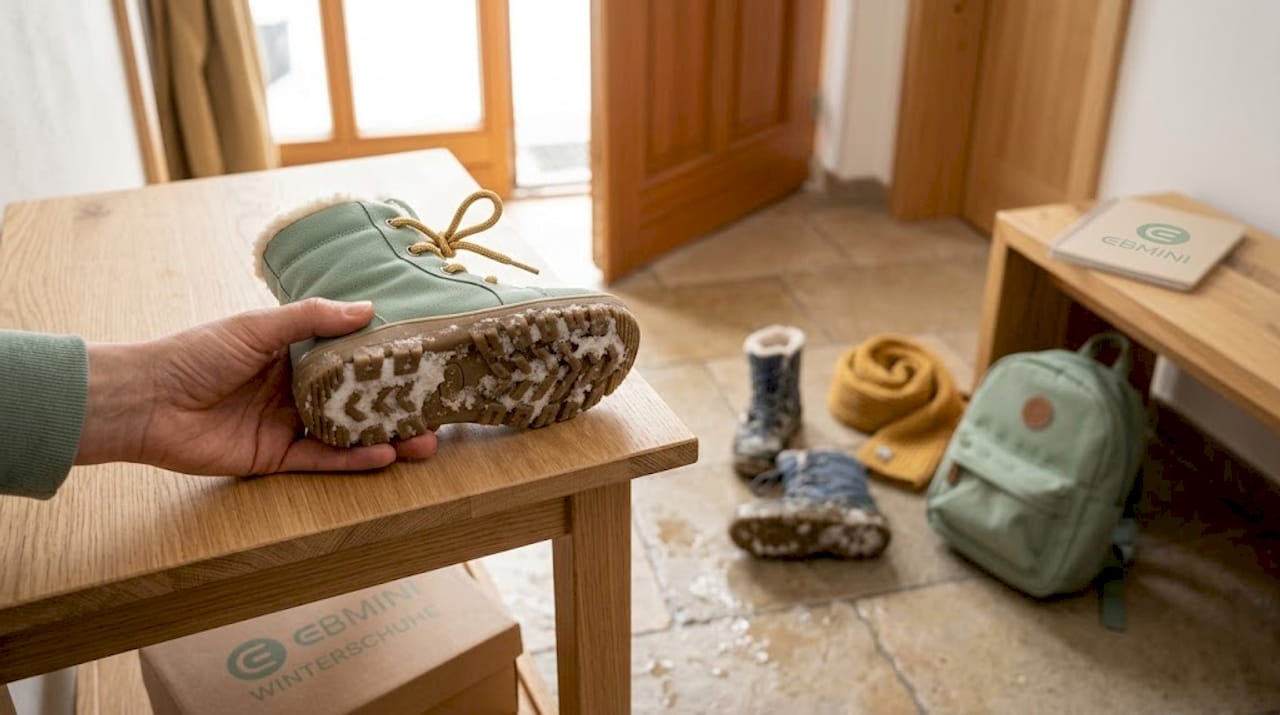
Children play with full enthusiasm in winter, whether on the swing, sledding, or romping through fresh snow. Many parents underestimate how dangerous unsuitable shoe soles can be on slippery surfaces. Slipping on ice and snow is one of the most common causes of accidents in children during the cold season, and in most cases, it's not the child's carelessness that's to blame, but the shoe on their foot. A grippy outsole is essential for secure footing on slippery ice and snow. In this article, you will learn what you can immediately and concretely look out for to better protect your child.
Table of Contents
- Why Grip is the Most Crucial Factor on Snow and Ice
- Scientific Innovations: What Traction Soles Can Really Do
- Materials, Sustainability, and Foot Health: What Else Parents Should Look For
- In Practice: How Parents Find the Right Model for Their Child
- Our Experience: Why There Isn't One Perfect Snow Sole
- Discover the Perfect Winter Shoes at Ebmini® Now
- Frequently Asked Questions
Key Insights
| Point | Details |
|---|---|
| Grip is Safety | A grippy, non-slip sole protects children from falls on snow and ice. |
| Technology vs. Everyday Use | Innovative traction soles help, but fit and everyday practicality are just as important. |
| Sustainability Matters | Parents should also look for non-toxic, sustainable, and foot-friendly materials. |
| Waterproof and Warm | In addition to grip, winter shoes must be waterproof and warm; otherwise, the best grip is useless. |
Why Grip is the Most Crucial Factor on Snow and Ice
A wet pavement at zero degrees, a slightly icy step in front of the kindergarten, a thin layer of snow on the playground: children encounter such situations daily in winter. For adults, these are everyday challenges they manage through experience. For a child aged two to ten, who is still actively training their center of gravity, the same situation can be potentially dangerous.
What the Sole Really Needs to Do
A shoe sole has one main task in winter: it must create friction where the shoes would otherwise slip. This requires three things simultaneously: the right tread pattern, the right rubber compound, and sufficient sole depth.
The tread pattern describes the shape and arrangement of the grooves and lugs on the bottom of the shoe. Deep, jagged profiles with many small edges grip into snow and ice, preventing the foot from slipping. Flat or smooth profiles, as found in many inexpensive models, offer little resistance on slippery surfaces.
The rubber compound is at least as important but rarely noticed by parents. Cheap, hard rubber becomes even stiffer in the cold and then loses almost all grip. High-quality rubber compounds, specifically developed for low temperatures, remain flexible and grippy even at minus ten degrees.
Important: A sole that looks good in the store can completely fail on ice if the rubber compound is unsuitable for cold temperatures.
Common Mistakes When Buying Soles
Many parents judge shoes by their appearance or brand name. The sole is often only briefly looked at, rarely thoroughly checked. Here are the most common mistakes made during purchase:
- Choosing too shallow a tread: A tread depth of less than four millimeters offers little safety on snow. Ignoring hard sole material: Press your thumb on the sole. Does it yield? If not, it's a risk in winter.
- Wearing worn-out soles for too long: Many parents let shoes be used until the very end. A worn-out sole no longer offers grip, no matter how good the original tread was.
- Not checking sole material: Cheap foam soles look like rubber but aren't.
Our winter barefoot shoes use specially selected rubber compounds that remain elastic in the cold and provide reliable grip.
Pro Tip: Check your child's shoe soles for wear at least once a month. A simple test: place a pencil across the tread. If it disappears completely into the groove, the sole is still good. If it lies on top, it's time for new shoes.
An important note for practical use: According to experts, the quality of the sole significantly determines whether a shoe is safe on ice. It's not about design, price, or brand name alone, but actually about the physics under your child's foot.
Scientific Innovations: What Traction Soles Can Really Do
Anyone who looks into winter shoes will quickly come across terms like "Arctic Grip," "Winter Traction," or "IceLock." These sound impressive. But what's really behind them, and when is the extra cost for a model with such technologies worthwhile?
Behind the Marketing Terms
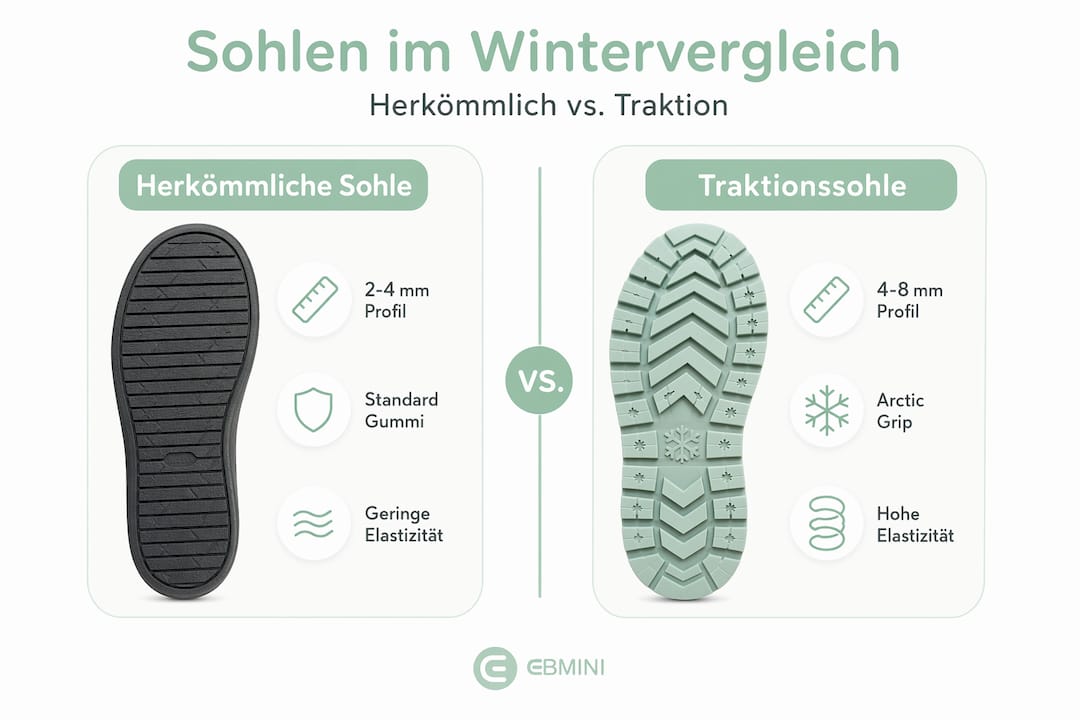
"Arctic Grip" is a technology originally developed by Vibram, one of the world's most renowned sole manufacturers. Its special feature lies in a specific rubber compound that adheres particularly well to wet ice. The trick: A film of water forms on wet ice, preventing adhesion. Arctic Grip soles are structured to displace this water film and establish direct contact with the ice. This actually works well, but primarily on wet, not dry, ice. Models with special traction soles for winter like Vibram Arctic Grip offer real advantages in certain situations but are not a cure-all.
Comparison: Conventional vs. Traction Soles
| Feature | Conventional Sole | Traction Sole |
|---|---|---|
| Tread Depth | 2 to 4 mm | 4 to 8 mm |
| Rubber Compound | Standard Rubber | Cold-Adapted, Soft |
| Grip on Wet Ice | Low | Good to Very Good |
| Grip on Dry Snow | Medium | Good |
| Weight | Lighter | Slightly Heavier |
| Durability | Medium | High to Very High |
| Price | Cheaper | Higher |
Which Technology is Suitable for Which Situation?
This is the really important question. A high-quality traction sole with Arctic Grip technology is ideal for:
- Icy paths children walk to school on in the morning
- Wet snow conditions around freezing point
- Excursions to alpine terrain or mountainous regions
For normal winter days in the city, playing in the snow, on the playground, or sledding in a field, high-quality, cold-flexible standard soles with deep treads are often perfectly sufficient. Here, comfort, freedom of movement, and fit are more important.
Overview of Pros and Cons of Popular Sole Types:
- Arctic Grip (e.g., Vibram): Very good grip on wet ice, slightly heavier, higher price, ideal for heavily iced routes
- Standard winter sole with tread: Lighter, cheaper, good grip on snow, less suitable for pure ice
- EVA foam sole: Light and comfortable, hardly any grip in winter, not recommended for outdoor temperatures below zero degrees
- Vibram Megagrip: Excellent on wet rock and mud, good on snow, expensive but durable
Our traction models compared show how modern soles can offer safety and freedom of movement simultaneously, without confining the child in a clumsy, heavy shoe.
Materials, Sustainability, and Foot Health: What Else Parents Should Look For
Grip and safety are the first considerations. But many parents we know also ask another question: Which materials are truly safe for my child? And which shoes genuinely support healthy foot development instead of hindering it?
Sustainable vs. Standard Materials Overview
| Criterion | Standard Materials | Sustainable Alternatives |
|---|---|---|
| Upper Material | Synthetic leather, PVC | Recycled polyester, organic cotton |
| Waterproofing | PFAS-containing (waterproof) | PFAS-free, fluorine-free waterproofing |
| Sole Material | Cheap hard rubber | Natural rubber or recycled rubber |
| Lining | Standard fleece | Organic wool, bamboo fiber |
| Harmful Substance Testing | Often not certified | OEKO-TEX Standard 100 or similar |
The difference is not only ecologically relevant. Materials like PVC or PFAS-containing impregnations are suspected of affecting hormones. For children's shoes worn daily for many hours, this is a real concern. Sustainable winter shoes are therefore increasingly positioned based on criteria such as recycled materials, PFAS- and PVC-free status, as well as wide fit and zero-drop soles.
Checklist: How to Recognize Non-Toxic Shoes
Simply looking at the packaging is not enough when buying. Instead, pay attention to:
- Seals such as OEKO-TEX Standard 100 or GOTS (Global Organic Textile Standard)
- Manufacturer statements regarding PFAS-free impregnation
- No noticeable chemical odors when unpacking
- Clear material specifications in the product text (no "synthetic" without further details)
- Recycled material components that are explicitly stated
Fit Check Step-by-Step
A healthy fit is just as important as the material. Here's the correct procedure:
- Check toe box: All toes should be able to lie straight and without pressure next to each other in the shoe. A wide toe box gives toddlers and schoolchildren the necessary freedom of movement for natural foot development.
- Check heel area: The heel must sit snugly in the shoe without slipping. A finger's width of space at the heel is too much.
- Consider width: Children often have wider feet than expected. Models that are too narrow press on the sides and hinder natural rolling motion.
- Measure length: There should be exactly one thumb's width of space between the longest toe and the shoe tip, no more, no less.
- Test weight: Lift the shoe. Does it feel heavy? For toddlers: Every unnecessary gram costs movement energy.
On our barefoot shoes blog, you can find more information on healthy foot development in children of different age groups.
Pro Tip: It's best to buy children's winter shoes in the afternoon, as children's feet tend to swell slightly during the day. A shoe that fits perfectly in the morning might pinch in the afternoon. Also, make sure your child wears the socks they would normally use with these shoes when trying them on.
If you would like to learn about children's shoes for spring and discover which shoes bridge the transition from winter to spring, you'll find seasonal recommendations for every age group there.
In Practice: How Parents Find the Right Model for Their Child
Theory is good. But what exactly do you do now for your next shoe purchase? Here's the practical side, step-by-step, without unnecessary jargon.
Step-by-Step Guide to the Right Choice
-
Define the area of use: Will the shoe primarily be used on sidewalks, in playgrounds, or for hiking in snowy landscapes? The requirements are different.
-
Assess the sole first: Take the shoe in your hand and look at the sole. Deep grooves? Soft, flexible rubber? These are good signs.
-
Check the weight: Place the shoe on your hand. Children under five should not have to wear shoes weighing more than 300 grams per shoe.
-
Perform a flex test: Bend the shoe from front to back. It should bend easily without resistance. A stiff shoe hinders the natural rolling motion of the foot.
-
Check material specifications: Are there indications of certificates, material origin, or freedom from harmful substances? If not, ask or look further.
-
Let them try it on: Let your child walk around in the shoes for ten minutes, preferably on a smooth floor. Does the child change their gait? Do they walk hesitantly or restricted? These are warning signs.
-
Check again at home: After unpacking, re-check socks and let them walk for ten minutes. Is anything pinching? Is the heel slipping out? Better to return them early than to let them pinch for weeks.
Where Parents Often Make Mistakes When Trying on Shoes
The most common mistake: Parents judge the fit by pressing on the outside of the shoe. This says little about the actual fit. Let the child stand and then feel the toe position from above themselves. Another mistake is to disregard the child's judgment. Even a three-year-old can say if something is pinching. Ask specifically.
In practice, experienced parents recommend that when buying winter shoes, in addition to the sole, attention should also be paid to waterproofness, warmth, and a precise, snug fit. These three factors together make a winter shoe truly suitable for everyday use.
Pro Tip: Mark the purchase date of your children's shoes with a small sticker inside the shoe. Winter shoes should be checked after a maximum of two winter seasons with normal use, even if they still look good. The sole wears down invisibly.
If you're wondering how demands change with the seasons, it's worth taking a look at our guide on Children's Shoes for Transitional Seasons, which explains when it makes sense to switch from winter to spring models.
Our Experience: Why There Isn't One Perfect Snow Sole
After all these criteria and recommendations, we want to be honest with you. There isn't one perfect shoe for all children and all winter situations. This statement may sound unsatisfactory, but it's the most useful truth we can give you.
Lab tests examine soles on controlled surfaces, at defined temperatures, and under standardized conditions. The playground in your neighborhood is not a testing laboratory. There are wet spots next to dry ones, ice patches next to loose snow, gentle slopes next to flat ground. Everyday testing experience consistently shows that no lab test can fully predict how a shoe will behave under real conditions.
It's particularly relevant that official test winners for children's snow boots from independent institutes like Stiftung Warentest are currently missing. This means there's no list that will make the decision for you. Instead, everyday observations, reviews from other parents, and your own child's feedback are the most valuable sources of information.
What we repeatedly experience in practice: A shoe that gives the neighbor's child perfect grip may perform less well for your child because foot shape, walking style, and movement rhythm are individually different. Children who strongly supinate while walking, meaning they walk on the outer edge of their foot, have different requirements than children who pronate.
Your child's joy of movement is an underestimated signal. A child who walks inhibited in their shoes walks more cautiously, tensely, and ultimately less securely. A shoe that feels good motivates more movement, more balance training, and thus, in the long run, more safety. That's not marketing; that's child physiology.
Our advice: Buy a shoe with good grip, healthy materials, and the right fit for your child. Then observe how your child walks. Do they walk freely, actively, and without hesitation? Then it's the right shoe. Do they walk cautiously or complain about pressure? Then, despite a good sole, it's the wrong one.
Don't hesitate to try different models if the first attempt isn't convincing. No parent should feel obligated by the purchase of an expensive model. Shoe comfort and safety are not areas for compromise.
Discover the Perfect Winter Shoes at Ebmini® Now
You now know what matters when it comes to grip, materials, fit, and sustainability. The next step is simple: Look at specific models that meet these criteria.
At Ebmini®, you'll find winter barefoot shoes for children aged one to ten, specifically developed according to barefoot principles: wide toe box, zero-drop sole, cold-flexible grip rubber, and certified pollutant-free materials. Each model is designed for actual everyday use, not just for display. Parents who want their children in shoes that offer real grip and simultaneously support healthy children's feet will find an honest selection in the Ebmini® range without unnecessary compromises.
Frequently Asked Questions
How do I recognize a non-slip sole on children's shoes?
Look for deep, jagged profiles with a grippy rubber compound, often referred to as "Arctic Grip" or similar. A grippy outsole is the most important feature for secure footing on slick ice and snow.
Are flexible barefoot soles or stiff traction soles better for ice?
Very flexible soles are good for everyday walking and promote natural foot development, but on thick ice, stiffer traction soles often offer more slip resistance. Flexible soles can have disadvantages on pure ice, while stiffer traction models offer clear advantages in this situation.
How important is waterproofing in addition to good grip?
Without dense materials, the shoe immediately loses its everyday usability and safety when wet. Experts recommend considering waterproofing and a snug fit in addition to the sole when purchasing.
Are there independent test winners for children's snow boots?
According to current information, Stiftung Warentest has not determined any official test winners for children's snow boots. Everyday observations and parent reviews are therefore particularly valuable sources of guidance.
What seals or certifications should I look for in foot-healthy children's shoes?
Prefer shoes with OEKO-TEX Standard 100 or APMA seals, as well as explicit information about recycled, PFAS-free materials. These labels guarantee tested freedom from harmful substances and responsible production.


