

Waterproof Kids' Shoes Explained Ecologically: A Parent's Guide
Waterproof shoes for children are footwear with a water-repellent membrane or coating that keeps moisture out while allowing breathability. This sounds technical, but it has a direct impact on your child's health and the environment. Many conventional models use PFAS-containing impregnations, i.e., per- and polyfluoroalkyl substances, which are hardly biodegradable in nature and are considered harmful to health. Environmentally explained waterproof shoes therefore mean: keeping children's feet dry without using harmful chemicals and without harming the environment. Brands like Allbirds and Ebmini show that both are possible simultaneously.
What materials are used for sustainable waterproof children's shoes?
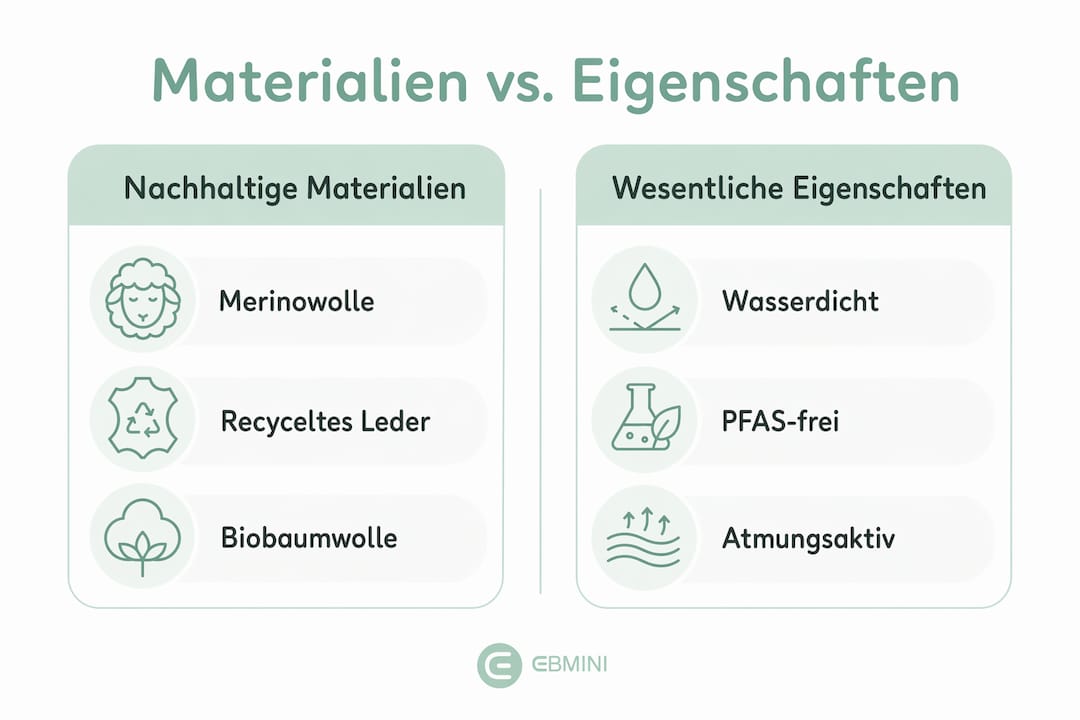
Sustainable, waterproof children's shoes are made from a combination of natural and recycled materials that offer both protection and environmental compatibility. Natural raw materials such as ZQ-certified merino wool, natural rubber, and vegetable-tanned leather are breathable, durable, and biodegradable. Recycled materials, such as upper fabrics made from recycled PET bottles, reduce raw material consumption and plastic waste in the environment. Allbirds combines these raw materials with a waterproof membrane in the Wool Cruiser Waterproof, providing a concrete example of practical implementation.
The crucial difference between sustainable and conventional materials lies in the impregnation. Conventional DWR (Durable Water Repellency) coatings often contain PFAS, PFOA, or PFOS. These substances are extremely persistent in the environment and accumulate in organisms. PFAS-free alternatives based on silicone, polyurethane, or wax offer comparable protection without these risks. The CZero project proves that equivalent water protection can be achieved without PFOA and PFOS.
| Material | Sustainable | Waterproof | Hazard Risk |
|---|---|---|---|
| Merino wool (ZQ-certified) | Yes | Conditional | Low |
| Recycled PET | Yes | With membrane | Low |
| Natural rubber | Yes | Yes (sole) | Very low |
| Conventional synthetic | No | Yes | High (PFAS) |
| PFAS-free PU coating | Yes | Yes | Very low |
Pro Tip: When buying, look for certificates like OEKO-TEX Standard 100, bluesign, or GOTS. These confirm that no harmful chemicals are detectable in the final product.
For parents who want to buy sustainable shoes, the material alone is not enough. How waterproofing is achieved is also crucial. A shoe made from recycled PET with PFAS impregnation is ecologically worse than a shoe made from conventional leather with a PFAS-free wax coating.
How do waterproof membranes work without harmful chemicals?
Waterproof membranes work on the principle of pore size. The membrane contains millions of tiny pores that are smaller than water droplets but larger than water vapor molecules. Water from outside cannot penetrate, while sweat from inside can escape. The result is a dry, breathable shoe. Known membrane types include Gore-Tex, eVent, and DrymaxX. Gore-Tex is the most famous name, but not automatically the most ecological.
The ecological challenge lies in the manufacture and coating of these membranes. Many classic membranes are treated with PFAS-containing chemicals to enhance the water repellency of the outer layer. New technologies no longer follow this path. The EC0Tex project is developing plasma technology with fluorine-free compounds, which enable extremely thin and efficient coatings without PFAS. Plasma coatings are considered a promising approach because they significantly reduce chemical use while providing high water repellency.
Here's how to identify ecologically sound membranes and coatings:
- PFAS-free declaration: The manufacturer explicitly states that no per- or polyfluorinated compounds are used.
- Transparent chemical information: Full disclosure of the substances used, not just a general sustainability promise.
- Recognized certificates: bluesign, OEKO-TEX Eco Passport, or GOTS confirm tested chemical standards.
- Manufacturer information on DWR method: Silicone, wax, or polyurethane instead of C6 or C8 fluorochemistry.
"Ecological risk assessment of DWR coatings is difficult due to data gaps. Documentable, transparent chemical information and certificates are better." DBU Project Database
Pro Tip: Ask the manufacturer directly about the DWR system used. Reputable suppliers will name specific substances or certificates. If the answer is vague, that's a warning sign.
This applies particularly to children's shoes. Children have thinner skin and absorb harmful substances more quickly than adults. A shoe produced in an ecologically clean way not only protects the environment but also directly protects your child's health.
How sustainable are waterproof children's shoes really?
Sustainability in waterproof children's shoes cannot be determined by material alone. It begins with raw material extraction, continues through production, and ends with disposal. Many PFAS-containing DWR coatings are insufficiently declared and pose environmental and health risks due to persistent pollutants. This means, specifically: a shoe can be made from recycled materials and still contain problematic chemicals if the impregnation is not transparently declared.
The production of sustainable textiles also requires high standards in occupational safety and waste management, otherwise new risks for people and the environment arise. Parents should therefore not only evaluate the final product but also ask under what conditions the shoe was manufactured. Certificates such as Fair Trade or SA8000 provide information on social standards in production.
These criteria will help you with the ecological evaluation:
- PFAS-free impregnation: Explicitly declared, not just implied
- Recycled or renewable raw material: Proportion of total material clearly indicated
- Eco-certificate for the final product: OEKO-TEX Standard 100 or comparable
- Transparent production chain: Traceable origin of materials and production site
- Durability: Quality that lasts several children or seasons reduces the ecological footprint per use
The DBU recommendation is clear: Parents should not only pay attention to the "waterproof" label, but also to transparent, named chemical information and environmental certificates to minimize ecological risks. A shoe without a certificate is not automatically bad, but a shoe with several recognized certificates has been demonstrably better tested.
For parents who want to learn more about breathability in winter, it's worth looking at the combination of membrane type and certification. Not every waterproof membrane is equally breathable, and not every breathable membrane is ecologically harmless.
Buying and caring for sustainable waterproof children's shoes
When buying sustainable, waterproof children's shoes, the combination of function, freedom from harmful substances, and durability is important. Waterproof shoes with membranes are particularly suitable for damp, cold regions, according to the Globetrotter guide. In warm climates, breathable shoes without a membrane are often the better choice because membranes dry more slowly. For German autumn and winter, however, membrane shoes for children are clearly advantageous.
Ebmini offers waterproof barefoot shoes for children with pollutant-free materials and transparent eco-standards. The special thing about barefoot shoes with water protection is the combination of natural foot development and all-weather function. Wide toe box, zero drop and flexible soles are retained, while the membrane keeps moisture out. This is a sensible combination for children who play outside a lot.
Sustainable models must also be durable in terms of care and use to truly realize their environmental benefits. Gentle cleaning and repair are crucial. If you care for your shoes incorrectly, you will destroy the membrane or impregnation and will have to buy new ones sooner. This not only costs money but also resources.
Specific care tips for sustainable, waterproof children's shoes:
- Cleaning: Only with lukewarm water and mild soap, never in the washing machine at high temperatures
- Drying: Air dry, not on a heater or in a tumble dryer, as heat damages membranes and adhesives
- Refreshing impregnation: Re-treat with a PFAS-free impregnating spray after about 20 to 30 uses
- Storage: Dry and ventilated, not in plastic bags, to prevent mold growth
- Repair: Small tears in the sole or upper material can often be repaired with special shoe glues before a new purchase is necessary
Pro Tip: Always refresh the impregnation of your children's shoes after washing. Water that no longer beads off is a sure sign that the DWR layer is wearing off and the shoe should be treated again.
For proper care in autumn and winter, a structured approach is worthwhile. Regularly caring for your shoes extends their lifespan many times over and thus significantly reduces the ecological footprint per year of use. Sustainable fashion and textiles follow the same principle: durability through care is the most effective way to conserve resources.
Key Takeaways
Sustainable waterproof children's shoes reliably protect children's feet from moisture when they combine PFAS-free membranes, certified materials, and transparent chemical information.
| Point | Details |
|---|---|
| Choose PFAS-free impregnation | Only buy shoes with explicitly declared PFAS-free DWR to avoid health risks. |
| Use certificates as a guide | OEKO-TEX Standard 100, bluesign, or GOTS confirm tested absence of harmful substances in the final product. |
| Critically compare materials | Recycled PET or merino wool alone is not enough. The coating method is just as crucial. |
| Care extends lifespan | Gentle cleaning and regular impregnation reduce the ecological footprint per year of use. |
| Combine barefoot principle and water protection | Models with a wide toe box, zero drop, and PFAS-free membrane promote foot health and sustainability simultaneously. |
What I've learned after years with sustainable children's shoes
Many parents ask us if a shoe can truly be waterproof and ecological at the same time. The honest answer: Yes, but only if you look closely. The most common misconception we observe is equating "sustainable material" with "ecologically harmless." A shoe made from recycled bottles with PFAS impregnation is not a sustainable shoe. It is a shoe with a sustainable raw material and a problematic process.
What drives us at Ebmini is the conviction that children deserve shoes that neither harm their health nor the environment. We have seen how difficult it is for parents to see through marketing promises. "Eco-friendly," "green," and "sustainable" are not protected terms. That's why we rely on concrete certificates and transparent material specifications, not buzzwords.
Another point that many overlook: The most ecological decision is often the most durable. A shoe that lasts two children is ecologically better than two cheap shoes that fall apart after one season. Quality and sustainability are not contradictory in children's shoes. They are one and the same.
My advice to all parents: Ask questions. Ask the manufacturer about the DWR system, about the certificates, about the production location. Anyone who doesn't give a clear answer probably doesn't have a good answer. And anyone who gives a clear answer usually has a good product.
— Ebmini
Ebmini® barefoot shoes for children: sustainable, waterproof and pollutant-free
Ebmini® develops waterproof barefoot shoes for children that consistently rely on pollutant-free materials and PFAS-free impregnations. Each model follows the barefoot principle with a wide toe box, zero drop and flexible sole, so that children's feet can develop naturally. For the cold season, Ebmini offers special warm, waterproof winter models that stay dry even in snow and mud. All products are manufactured with transparent eco-standards and are comprehensibly documented for parents. If you are looking for sustainable, pollutant-free shoes for active children, Ebmini offers models that combine foot health and environmental responsibility.
FAQ
What does PFAS-free mean for waterproof children's shoes?
PFAS-free means that no per- or polyfluorinated alkyl substances were used in the impregnation. These substances are hardly biodegradable in nature and are suspected of being harmful to health, which is why PFAS-free alternatives are clearly preferable for children's shoes.
How do I recognize sustainable waterproof shoes when buying them?
Look for certificates such as OEKO-TEX Standard 100, bluesign, or GOTS, as well as explicit statements about PFAS-free DWR coating. Manufacturers who transparently disclose their chemicals are more credible than those who only make general sustainability promises.
How often do I need to re-impregnate children's shoes?
After about 20 to 30 uses or after each cleaning, the impregnation should be refreshed with a PFAS-free spray. A sure sign is when water no longer beads off the surface.
Are barefoot shoes also suitable as waterproof shoes for children?
Yes, modern barefoot shoes with a waterproof membrane combine natural foot development with all-weather protection. Models with a wide toe box, zero drop, and PFAS-free membrane, such as those offered by Ebmini, are well suited for wet and cold conditions.
Which materials are best for eco-friendly shoes in rain and mud?
Recycled PET for the upper, natural rubber for the sole, and a PFAS-free polyurethane or silicone membrane are considered an ecologically sound combination. It is important that all components are certified and transparently declared.


